
I first wrote about AI in January 2023, when ChatGPT was still a relatively new phenomenon. I had a great use case for it. Like many of us, I struggle to promote myself and sing my praises, as humility has been deeply ingrained in my neural wiring. I gave all my customer feedback and reviews to ChatGPT and asked it to write a post using that material to promote me.
I haven’t written about AI since then. It’s not part of my core offering as a coach, and while I expect AI will revolutionize the coaching industry, as it will almost all other industries, that’s not where my interests lie. I coach because I treasure human connection.
And yet, AI is unavoidable. It surfaces in the majority of my coaching conversations these days, whether it’s a passing mention of how AI could be helpful or sessions dedicated to supporting a leader as they navigate the AI landscape.
Today’s post comes at the request of one of those leaders. Following the insights we discussed in one of our sessions, they literally begged me to put what we discussed into a post to help them and their organization understand how to embrace AI effectively.
If you’re a leader struggling to embrace AI, this post will help you get started. If you’re a leader working to convince your colleagues to adopt AI, this post will help you get them started.
The Pace of Change
We have seen countless technological innovations over the decades, including the Internet, personal computers, smartphones, and cloud computing. Each one has had a profound impact on the world. It’s safe to say AI’s impact will be equally profound. What’s strikingly different is the pace at which AI is evolving and being embraced.
To put this in perspective, I’ll use Gartner’s Hype Cycle.
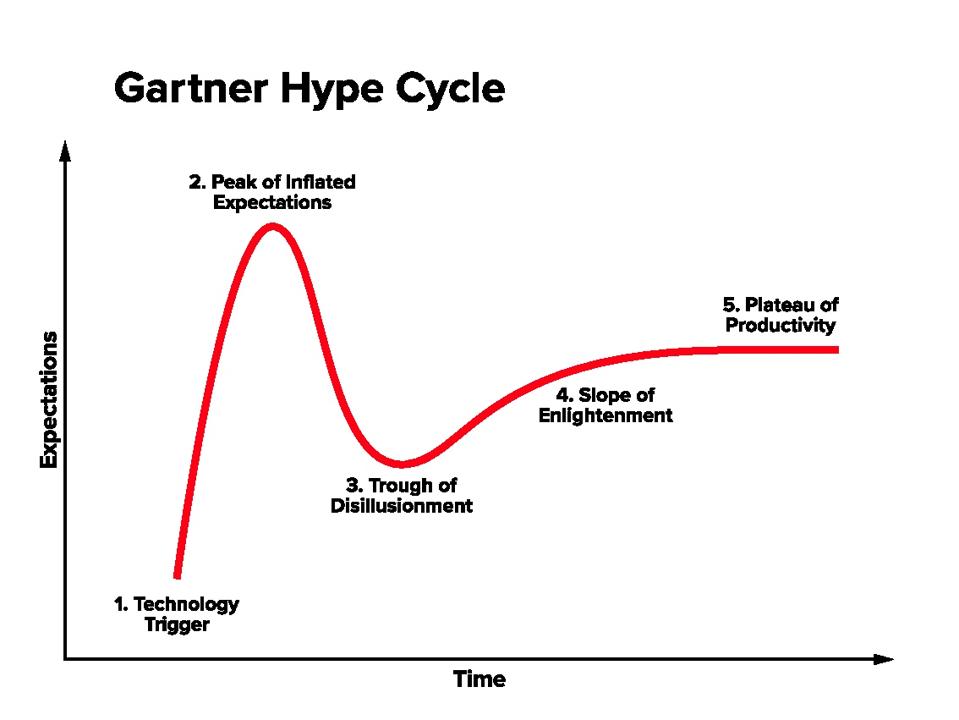
Here’s an explanation of the Hype Cycle from Gartner’s website:
Each Hype Cycle drills down into the five key phases of a technology’s life cycle.
- Innovation Trigger: A potential technology breakthrough kicks things off. Early proof-of-concept stories and media interest trigger significant publicity. Often no usable products exist and commercial viability is unproven.
- Peak of Inflated Expectations: Early publicity produces a number of success stories — often accompanied by scores of failures. Some companies take action; many do not.
- Trough of Disillusionment: Interest wanes as experiments and implementations fail to deliver. Producers of the technology shake out or fail. Investments continue only if the surviving providers improve their products to the satisfaction of early adopters.
- Slope of Enlightenment: More instances of how the technology can benefit the enterprise start to crystallize and become more widely understood. Second- and third-generation products appear from technology providers. More enterprises fund pilots; conservative companies remain cautious.
- Plateau of Productivity: Mainstream adoption starts to take off. Criteria for assessing provider viability are more clearly defined. The technology’s broad market applicability and relevance are clearly paying off.
Gartner argues that every innovation evolves following this cycle. This is a powerful model to understand why AI’s impact has become so profound so quickly.
I asked AI to play the role of a Gartner Analyst and compare the hype cycles of AI with those of the other innovations I mentioned.* I then asked it to generate visuals for this article. Here are the results of my prompts:
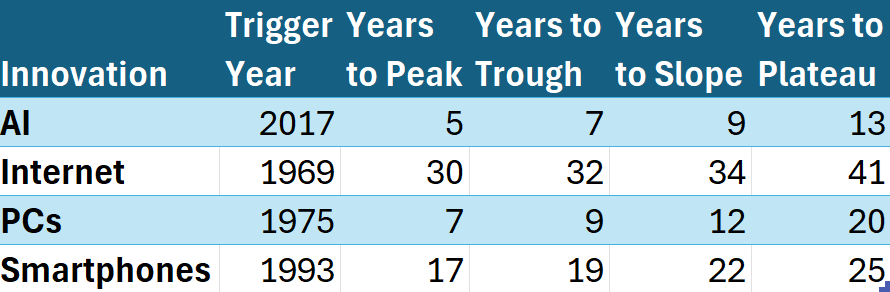
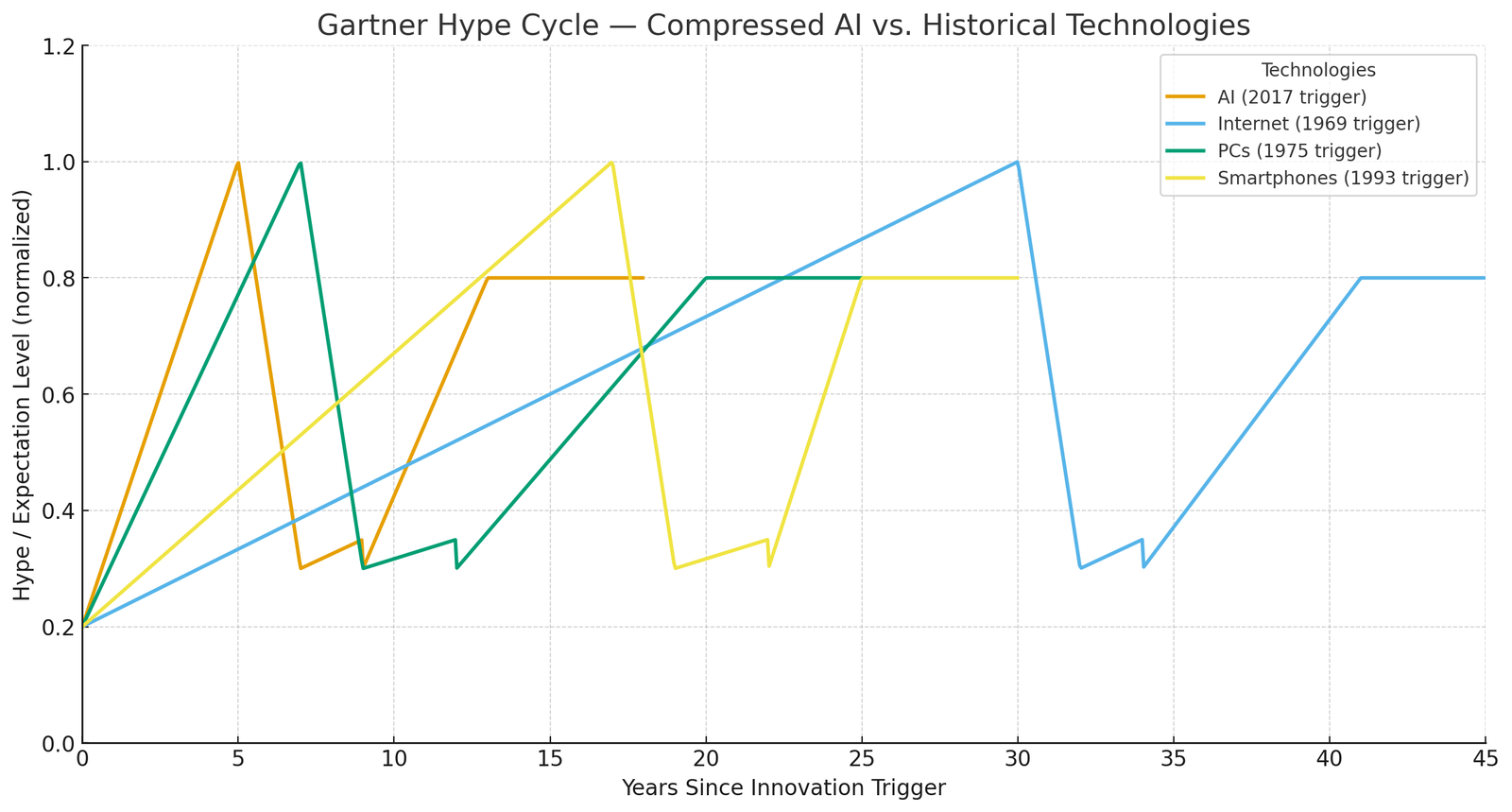
We can see how much faster AI is progressing through the hype cycle than other innovations. This, in part, explains why there is so much buzz around AI. It took only five years to reach the peak of inflated expectations. Smartphones took 17 years to get there, and the Internet took three decades.
You may disagree with these numbers, but the point is that AI is evolving more rapidly than any technology that has come before it. However, this only tells part of the story.
Unparalleled Access
The other reason AI has taken off so rapidly is access. I asked AI to give me a timeline for the rollout of ChatGPT:
- November 30, 2022 – research preview launched, available primarily in the US
- January 2023 – ChatGPT is available to most major countries in North America and Europe, as well as parts of Asia
- February 2023 – ChatGPT was functionally available to the majority of countries worldwide
Within three months of ChatGPT’s initial launch, it was available, free of charge, to nearly anyone with internet access worldwide. Not long after, free alternatives emerged, including Anthropic’s Claude, Microsoft’s Copilot, and Google’s Gemini.
Let’s put that in perspective. In 1981, Gates began publicly sharing Microsoft’s formal mission statement: “A computer on every desk and in every home, running Microsoft software.” Twelve years later, I started my first job after college, and I had a dumb terminal on my desk.
Can you imagine if Gates had announced in 1981 that every person in the US would find a PC on their doorstep that day, and the rest of the globe would receive their PCs within three months? For free?
Or if Apple shipped iPhones to everyone around the planet, for free, within three months of their launch? And not to be outdone, Google and RIM quickly followed suit, sending Android and BlackBerry devices to everyone as well.
Unparalleled Applications
The final leg of the stool is the incredible application of AI. The Internet started as a Department of Defense technology. Slowly, over the course of decades, other use cases emerged, and gradually, more and more people found practical uses for the Internet. The same is true of PCs and even Smartphones. Adoption initially began in specific business applications and, over time, became more widespread and universal.
AI, on the other hand, delivered immediate, practical value to everyone. In business, it’s not a technology limited to IT and software development – there are use cases for every role. And outside of business, the same is true. Nearly every person on the planet can get value immediately from AI – they just have to know what to ask and how to ask it.
As a result, businesses are quickly realizing AI is not a technology project. IT needs to be involved in managing and rolling it out, but every employee must become literate in AI and start identifying ways that AI can enhance their productivity.
If you are still building your AI literacy, I hope this helps you understand the urgency behind it. If you are assisting colleagues in developing their AI literacy, hopefully, this will enable you to tell the story more effectively and get them engaged.
Some Practical Advice
A client recently recommended The Ai-Driven Leader by Geoff Woods. If you, like me, haven’t given up on old-fashioned book-learning, this is a great place to start. It’s written for leaders in all areas of an organization. It won’t help a developer figure out how to use AI to write code. It will help a leader build a base level of literacy, understanding the potential and the pitfalls. It offers practical advice (and numerous compelling prompts) on how to preserve your role as a thought leader, leveraging AI as a thought partner.
I’ve also been watching the activity of a former client, UDig, as they rolled out their AIgnite initiative. Joshua Bartels calls it “controlled chaos,” and his CEO jokes he is the “Chief Chaos Officer.” They’ve challenged every employee to embrace AI and start experimenting with it every day, then share their successes and failures with their colleagues. Every employee is rapidly navigating the learning curve and figuring out how AI can enhance their productivity.
Putting It Into Practice
If your teams are struggling to understand why AI has become so important so quickly, use this post as a resource to help them understand how we arrived at this point.
Build your AI literacy and expertise. If you’re unsure where to start, consider asking AI for guidance. “I’m new to AI, and I’m not sure how it can help me. Please interview me, one question at a time, and provide ten ideas about how I can use AI to be more productive.”
Ask yourself whether you and your teams are doing enough to embrace AI. Consider an initiative like UDig’s AIgnite to accelerate the learning process.
* I am not here to debate the validity of the hype cycle, and I am not a researcher. While we can debate the details, I consider the speculations in this post to be directionally accurate enough to illustrate my points.