
It’s safe to say I read a lot. Certainly more than the average bear*. I’ve often felt my reading was more about quantity than quality. Recently, I’ve experienced a profound shift in my relationship with reading that may inspire you to re-evaluate your own.
Reading as Achievement
My love of reading has long been intertwined with a lifetime of conditioning around achievement and getting things done. The Maximizer in me has constantly sought out hacks to read as efficiently as possible. How did I pass the time when I was running fifty miles a week? A lot of audiobooks at 1.5x speed. I had a Kindle app loaded with electronic books I could read in five-minute doses, standing in line at the grocery store or sitting in a doctor’s waiting room.
At some point in the aughts**, a friend shared a word cloud with me of “Books Everyone Should Read.” I wanted to read more of The Classics, and here was a beautiful roadmap for becoming more well-read. I began highlighting each book I’d read and worked on filling out the whole thing. Along the way, Tim Musselman undertook the same project, and it became a friendly competition as we chronicled our progress, reviews, and ratings of each book on the list. I finished first, but granted, I had a headstart. And Tim often took issue with my preference for audiobooks over print.
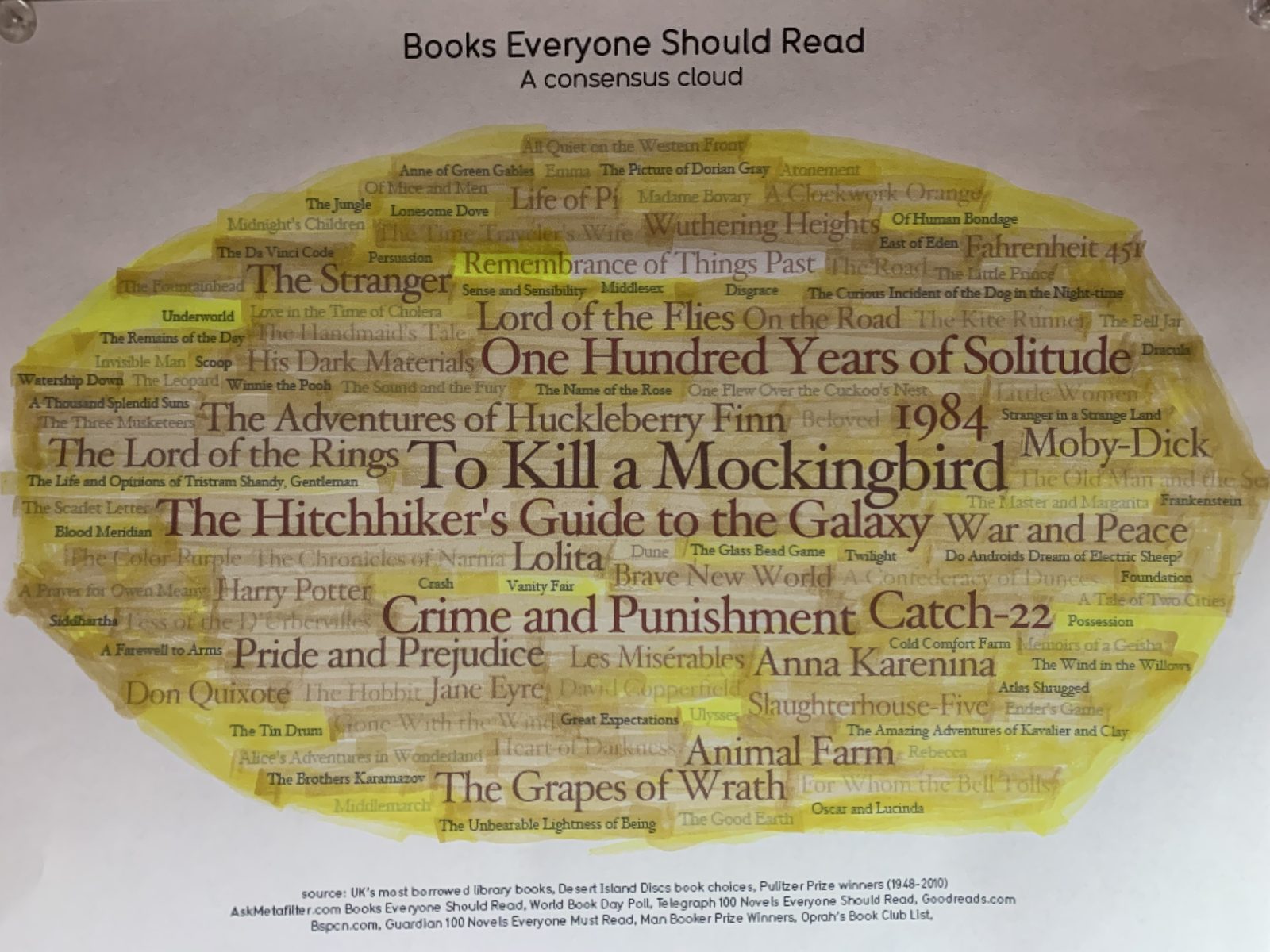
Having completed that journey, I am arguably more well-read, but the truth is, for many of those books, I couldn’t tell you a thing about the plot. I could re-read them now and feel like I was reading them for the first time.
I have read so many books focused on checking them off the list. There have been many books that have stuck with me. Books that have taught me great things. But also many, many books that I read for the sake of completion, with little comprehension or retention.
If you are familiar with StrengthsFinder, this is the shadow side of my convergence of Input, Maximizer, and Achiever strengths. A thirst for knowledge, satisfied with incredible efficiency, for the sake of achievement.
Over the past few months, my relationship with reading has changed in a delightful way.
Contemplative Reading
The first seed of change for my reading experience was planted two years ago. I don’t remember the experience that prompted it, but I know that in early 2024, I added a potential blog post to my backlog of topics. The working title was “Teliodosis Reading.” I had read something and felt a deep connection to the author. I read not as a reader of the words on the page, but through the eyes of the author as they were writing those words. There was a presence in my reading that shifted me from a doing mindset to a being mindset. I felt empathically connected to the author.
It took that seed a long time to germinate, but I think it is finally bearing fruit, thanks to two gifts.
The First Gift
The first gift was my meditation retreat last December. I emerged from that retreat with an intentional shift in my daily schedule, aided by the year’s natural wind-down, leaving more space in my calendar. The retreat schedule had me waking at 5:15 each morning and in bed by 9. This became my norm, and I now routinely wake between 5:30 and 6 and move straight to meditation to start my day.
Waking that early gives me the time and space for a robust morning ritual. By the new year, it had expanded:
- Wake up, changing my phone’s focus from Sleep to Stillness. This allows me to shut off the alarm (I typically wake before it goes off) without letting any notifications slip through.
- Wash my hands, brush my teeth, take my supplements.
- Meditate.
- Make coffee.
- Engage in contemplative reading and writing.
That entire routine can be 90 to 120 minutes, and I don’t take my phone out of Stillness focus until it’s done. This allows me to be fully present with my meditation, reading, and writing without the interruptions of the outside world and the lure of email, news, podcasts, social media, etc.
I’ve found reading to be a very different experience within this ritual. There is no race to get to the end. I’m deeply present with what I’m reading, rather than fending off my wizards that want to intrude with other things to think about. If something is dense, I read it multiple times. There is no goal for how much I will read each morning. It is incredibly satisfying.
The Second Gift
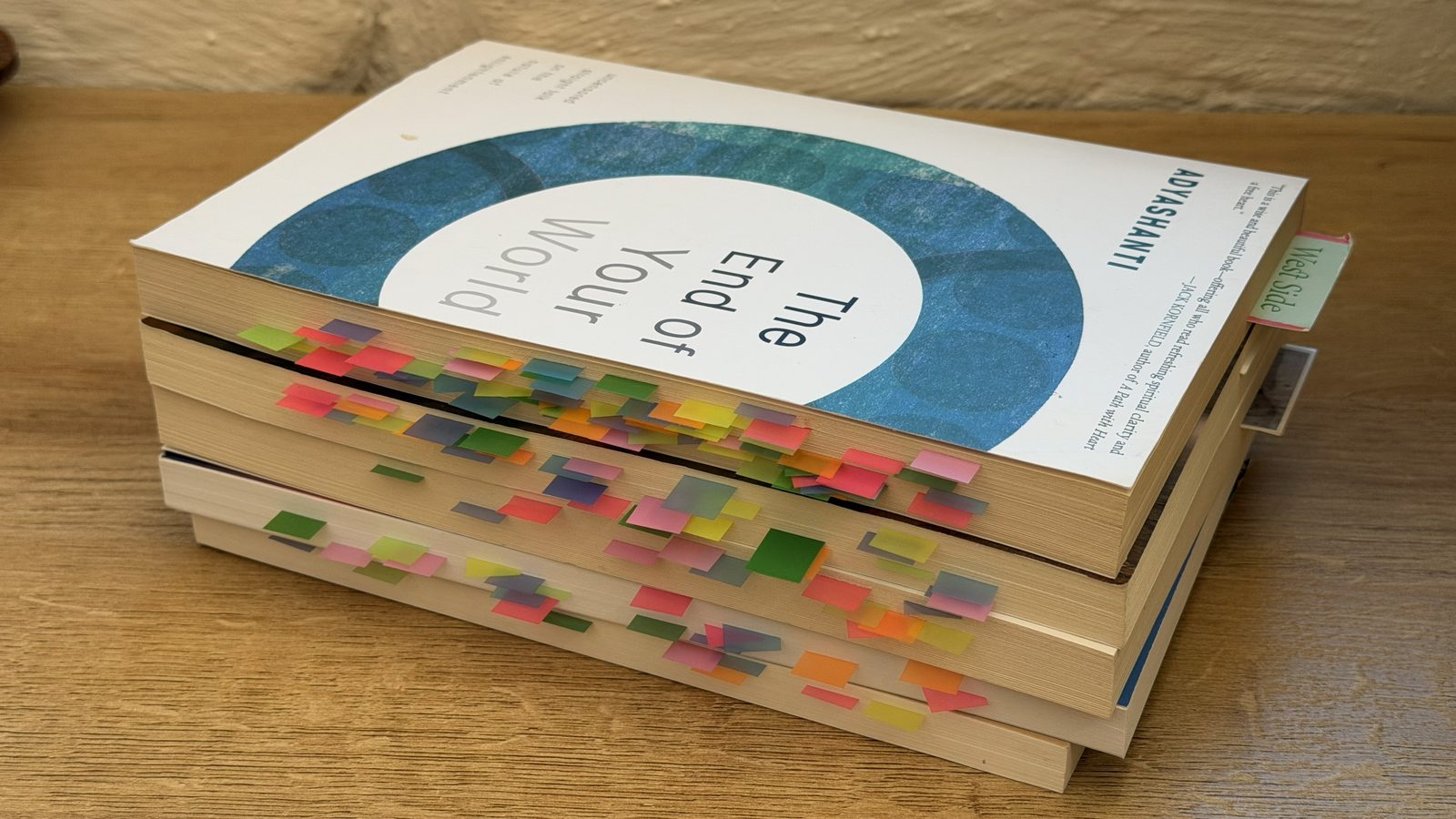
My second gift was a book loan. I was having lunch with a friend, and she thought I might enjoy reading a book from her library. The actual book is immaterial. The gift was the fifty or so little colored stickers gracing the pages, flagging every passage of the book that intrigued her.
As I read this book, I realized I had a mental block around highlighting passages in a physical book. As I unpacked it, I found several underlying contributors:
- Highlighting a book brought me back to my college days and made it feel like studying and work.
- I felt uncomfortable marking up a book.
- Even if I did highlight or underline, how would I find the references again?***
My friend’s simple use of stickers cleared away the mental block and further deepened my reading practice. I wasn’t just reading more slowly and thoughtfully. I was also looking for insights that really hit home and for a way to capture them cleanly. Not so I could return and cram for an exam. To notice. To pause and reflect.
Reading my friend’s book didn’t just give me the idea to use stickers. Her stickers were an insight into her mind. I could see which passages resonated most with her, as if we were in an asynchronous book club. I’ve found that also shapes how I read. On one level, my stickers capture what in the book is important to me. But on another level, I’m thinking about what I would highlight for the friend to whom I loan this book in the future. What passages would I want to call out for them as they read?
Putting It Into Practice
What’s your reading style? Do you “read for speed” as I have often done, or do you savor a book and let it nourish your soul? A few thoughts to deepen your reading:
- Find a dedicated time in your day for contemplative reading, even if it’s only 15 minutes.
- Don’t set a reading goal. Allow yourself to read at whatever pace feels natural.
- Be present with the author in their act of writing, not just the words on the page.
- Find a highlighting or note-taking strategy that deepens your understanding.
* I didn’t remember where this saying came from – it’s from Yogi Bear, who often described himself as “Smarter than the average bear.”
** This term is up there with fortnightly as a word we need to get into the mainstream. There is just no clean way to refer to the first decade of the millennium.
*** My beat-up copy of Zen and the Art of Motorcycle Maintenance has underlining, and a list on the inside cover of all the pages where I have underlined something to make it easier to find them.