

Engagement. It’s the holy grail of employee performance. When our employees are highly engaged, they do their best work. They are in flow. They love their work, their colleagues, and their clients.
When employees are disengaged, they may do the bare minimum. Their work is below what they are capable of. They may be looking for their next opportunity.
As AI takes the world by storm, I think many of us are losing sight of this fundamental ingredient for success. Here are some thoughts on how to help you and your team stay highly engaged, both professionally and personally.
Disengaged
Can you recall a time when you felt disengaged at work or in your personal life? How did it feel?
(I realize you probably blew right past that and kept reading, but I encourage you to take a moment and really think about the question, and connect with your body and your emotions around those questions, and see what arises).
Often when I talk with clients in this space, work is boring. They may still have more work than they can handle and feel stressed out by the workload, but the work is not stimulating. Sometimes they have been doing the same job for several years. There are new problems, but they are always the same flavor. In other cases, they don’t feel empowered. There are guardrails in place that keep them on a narrow path.
This is a space of low energy. From a neuroscience perspective, a lack of stimulation and engagement leads to deficits in neurotransmitters such as dopamine and norepinephrine. That deficit hampers the effectiveness of your prefrontal cortex (PFC)*. You may experience brain fog, memory lapses, poor decision-making, and a lack of empathy. Your under-resourced PFC will keep you from doing your best work.
Due to the lack of novelty and stimulation, we find ourselves stuck in our comfort zone. The work may feel easy, but it becomes harder and harder to focus on it, and we find ourselves unable to make new connections and come up with innovative solutions.
When we (or our teams) are stuck in our comfort zone, the obvious solution is to push our way out. The challenge is that we often push too hard, too fast.
Overly Engaged
Most of the clients I work with don’t feel stuck in their comfort zone. Usually, it’s quite the opposite. They have been stretched too far, too fast. They’ve been given stimulating, challenging problems to solve, without enough support to succeed.
These clients are in the danger zone. I wrote about my experience here in my Clearing the Fog post a few years back. I was under so much stress that my PFC was flooded with neurotransmitters. In our comfort zone, we don’t have enough. In the danger zone, we have too many. Either way, the results are the same. I had brain fog. I had trouble remembering things. I had poor impulse control and made poor decisions. I felt like I was getting a lot done, but in hindsight, it certainly was not my best work.
Are you in the danger zone? Are your team members in the danger zone? For many reading this now, I suspect the answer is yes, and just like when you’re stuck in your comfort zone, you’re not doing your best work.
Optimally Engaged
The term I love for that sweet spot between your comfort zone and the danger zone is the learning zone. When we are in the learning zone, we have a high degree of stimulation. We are open to new ideas. Our PFC has the right balance of neurotransmitters, allowing us to make better decisions, relate to others more effectively, improve memory, better regulate our emotions, and make new connections that generate innovative ideas.
When we are in the learning zone, we find ourselves in a state of flow. Work doesn’t feel like work. Our productivity increases dramatically. I can remember when I was a programmer, and we were rewriting our student system. I was in such a state of flow that I’d head home at the end of the day, eat dinner, and get right back on my computer to keep coding, because there was nothing I would rather do.
It’s a simple, yet incredibly powerful model that comes up time and again in my coaching sessions. If you have an employee who isn’t at their best, ask yourself where they sit in the engagement zones. Are they stuck in their comfort zone? Are they in the sweet spot of the learning zone? Or have you pushed them too far into the danger zone?
Getting In The Zone
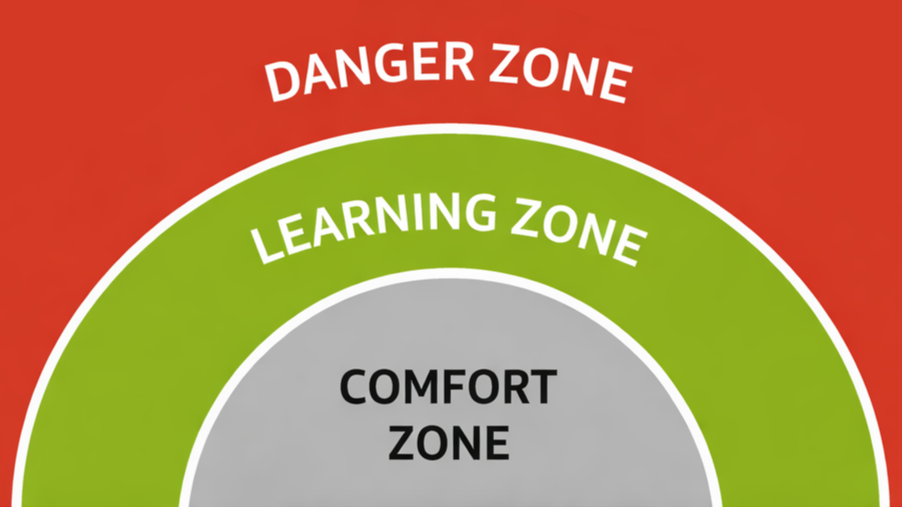
If you have an employee stuck in their comfort zone (or yourself), you’ll want to add stimulation. I look for novelty. Can you find a stretch assignment that triggers new learning? Can you gamify the work with a colleague to make it more interesting? Perhaps you’re not delegating enough to them. Find something that adds stimulation and gets them out of their rut, without pushing them so far that they are in the danger zone.
On the other hand, if you’ve pushed an employee into the danger zone, it’s time to dial it back. You may have delegated something they aren’t ready for, and they need mentoring or other support to succeed. They may need help clarifying priorities so they can focus on the most important things first. They may need permission to tell you or others “No.” Paradoxically, if you take some work off their plate so they can get into the learning zone, their productivity will improve.
Most importantly, check in with your employees. Don’t assume you know what zone they are in. Create a safe space where they can speak openly with you, so you can work collaboratively to help them enter the learning zone.
Putting It Into Practice
Take some time to reflect on the comfort zone, the learning zone, and the danger zone. Check in with yourself daily to honestly assess which zone you’re in, and identify strategies to help you shift if needed.
Share this simple model with each of your employees, and ask them which zone they are in. Provide the leadership and support they need to get into the learning zone if they aren’t already there.
* I learned the neuroscience behind this in my coach training with BEabove Leadership. See Ann Betz’s Goldilocks of the Brain post for a more detailed explanation.
I am an executive coach and life coach with software executive roots in higher education and EdTech. I coach because I love helping others accelerate their growth as leaders and humans. I frequently write about #management, #leadership, #coaching, #neuroscience, and #arete.
If you would like to learn more, schedule time with me.